
How to Read a Puppy Food Label in the US
On a US puppy food label, read the nutritional adequacy statement first. It should say the food is complete and balanced for growth, including growth of large-size dogs if your puppy is expected to reach 70 pounds or more. Then check calories per cup or can, the feeding guide, lot code, and manufacturer contact.
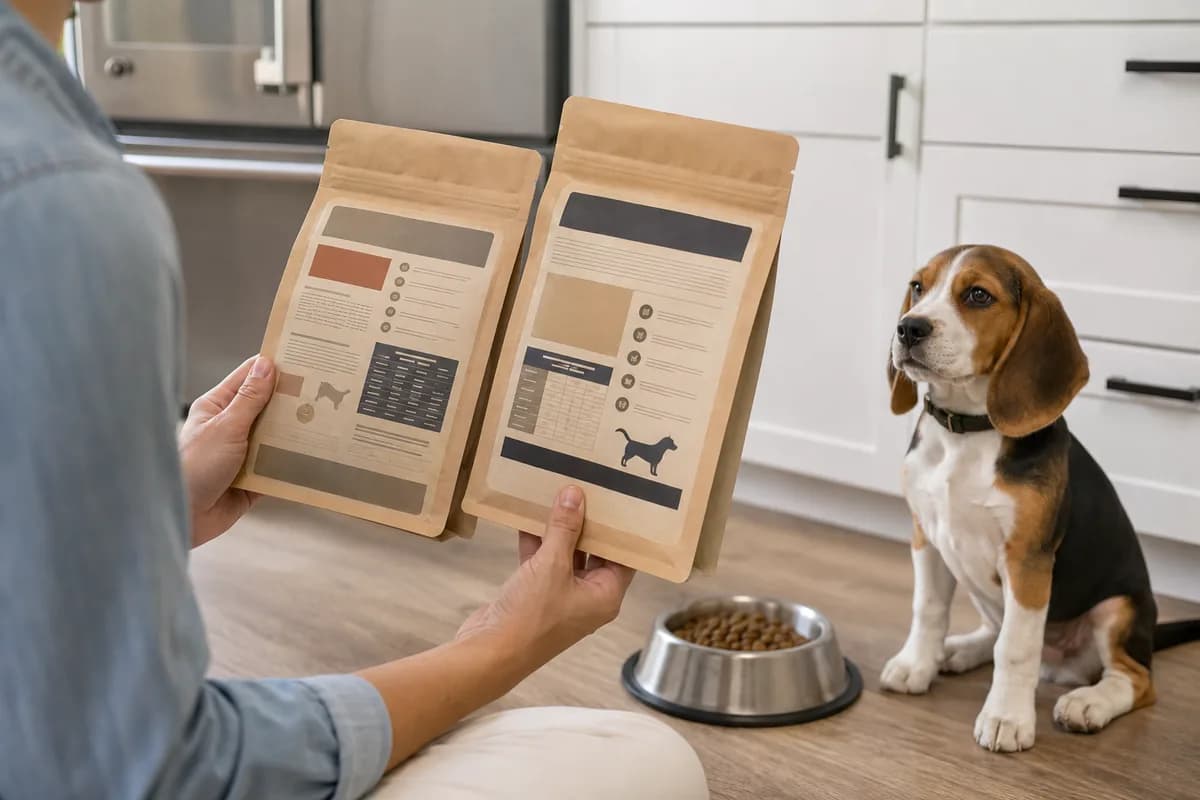
Where is the most important sentence on a puppy food label?
Turn the package over and find the nutritional adequacy statement. It is often in small print, but AAFCO calls it the most important part of the label because it connects the food to a life stage (AAFCO label guide).
For a puppy, look for wording that says the food is complete and balanced for growth or for all life stages. “Intermittent or supplemental feeding only” does not describe a complete everyday diet.
If your puppy is expected to weigh 70 pounds or more as an adult, the growth claim should specifically include large-size dogs. Do not assume that a picture of a large puppy on the front supplies that assurance; read the formal statement.
What does “complete and balanced” mean in the United States?
The FDA explains that a food can support this claim by meeting an AAFCO nutrient profile for the stated life stage or by passing an AAFCO feeding trial. Growth and adult maintenance are different profiles because a growing dog has different nutritional requirements (FDA complete-and-balanced explainer).
The statement may say the food was formulated to meet a profile or that animal feeding tests substantiate the claim. Both are recognized routes. It does not mean AAFCO approved or endorsed that brand.
Which other parts should I check?
Use this order so front-of-bag marketing does not distract from the useful facts:
| Label section | Question to answer |
|---|---|
| Intended species and life stage | Is it dog food appropriate for growth? |
| Large-size growth qualification | Does it include puppies expected to reach 70 pounds or more? |
| Calorie content | How many kcal are in a cup, can, or other familiar unit? |
| Feeding directions | What starting amount does the maker provide? |
| Guaranteed analysis | Which nutrient minimums and maximums are declared? |
| Ingredient list | What was included, in descending order by pre-processing weight? |
| Manufacturer or distributor | Can you contact the company and preserve the lot code? |
Federal labeling rules cover product identity, net quantity, manufacturer or distributor, and ingredients; states commonly use AAFCO model regulations for additional pet-food requirements (FDA animal-food labeling).
What cannot the label tell me by itself?
The ingredient list does not tell you the exact quality of the finished product. The guaranteed analysis also cannot directly compare wet and dry foods unless you account for moisture. Labels do not reveal every quality-control practice, who formulated the diet, or whether the company can provide a typical nutrient analysis.
Ask the manufacturer for calories, typical analysis, formulation expertise, and quality-control information when those details are missing. Bring the full label and your puppy's growth record to veterinary visits rather than relying on the front panel.
Once you know the food is appropriate, enter its calories into the PawAI Puppy Plan and adjust the label's starting amount against your puppy's trend. For the portioning process, see puppy feeding amounts by age, and use how PawAI calculates to inspect the calorie assumptions.
Sources
Frequently asked questions
Does an AAFCO statement mean AAFCO approved the food?
No. AAFCO does not approve individual pet foods. The statement identifies the nutritional standard or feeding-test method used to support the complete-and-balanced claim for a particular life stage.
Is the first ingredient the best way to choose puppy food?
No. Ingredients are listed by weight before processing and do not reveal the finished food's digestibility, calorie density, quality control, or overall nutrient balance. Start with adequacy, life stage, calories, and manufacturer information.
Put this into practice
Calculate your pet’s daily calories →Curious how the numbers work? See how we calculate.
This article is educational and is not veterinary advice. For a diagnosis or a treatment plan, consult a licensed veterinarian who can examine your pet.