
When to Switch From Puppy Food to Adult Dog Food
Switch from puppy food when rapid growth is ending and your veterinarian agrees the dog is approaching skeletal maturity. Small dogs often reach that point earlier than large or giant dogs, so the first birthday is not a universal deadline. Transition gradually over about a week while monitoring stool, appetite, weight, and body condition.
Why isn't the first birthday a universal switch date?
Dogs mature at different rates. AAHA defines puppyhood as birth through the end of rapid growth, commonly around 6–9 months but varying with breed and size (AAHA life-stage definitions). That definition does not mean every dog should eat adult food at nine months. Skeletal growth continues longer in many large and giant breeds.
Use age as a reminder to review the diet, then make the decision from growth, expected adult size, body condition, reproductive status, activity, and veterinary assessment.
| Expected adult size | Common time to review the switch | Why it varies |
|---|---|---|
| Small | Around 9–12 months | Rapid growth usually ends earlier |
| Medium | Around 12 months | Individual and breed variation remains important |
| Large | Around 12–18 months | Skeletal maturation often continues beyond one year |
| Giant | Around 15–24 months | Some dogs need controlled growth nutrition for longer |
These are review windows, not deadlines. AAHA notes that skeletal maturity in some large and giant dogs may not occur until about 15–16 months (AAHA age-specific diets).
What signs suggest the transition is approaching?
Look for a growth curve that is flattening, a puppy close to expected adult height, stable lean body condition, and a veterinarian who agrees that rapid growth is ending. Neutering alone does not prove skeletal maturity, although the calorie amount may need review after energy needs change.
Choose an adult food with a nutritional adequacy statement for adult maintenance. The FDA explains that growth and maintenance use different nutrient profiles because life-stage needs differ (FDA complete-and-balanced guidance).
How should I transition the food?
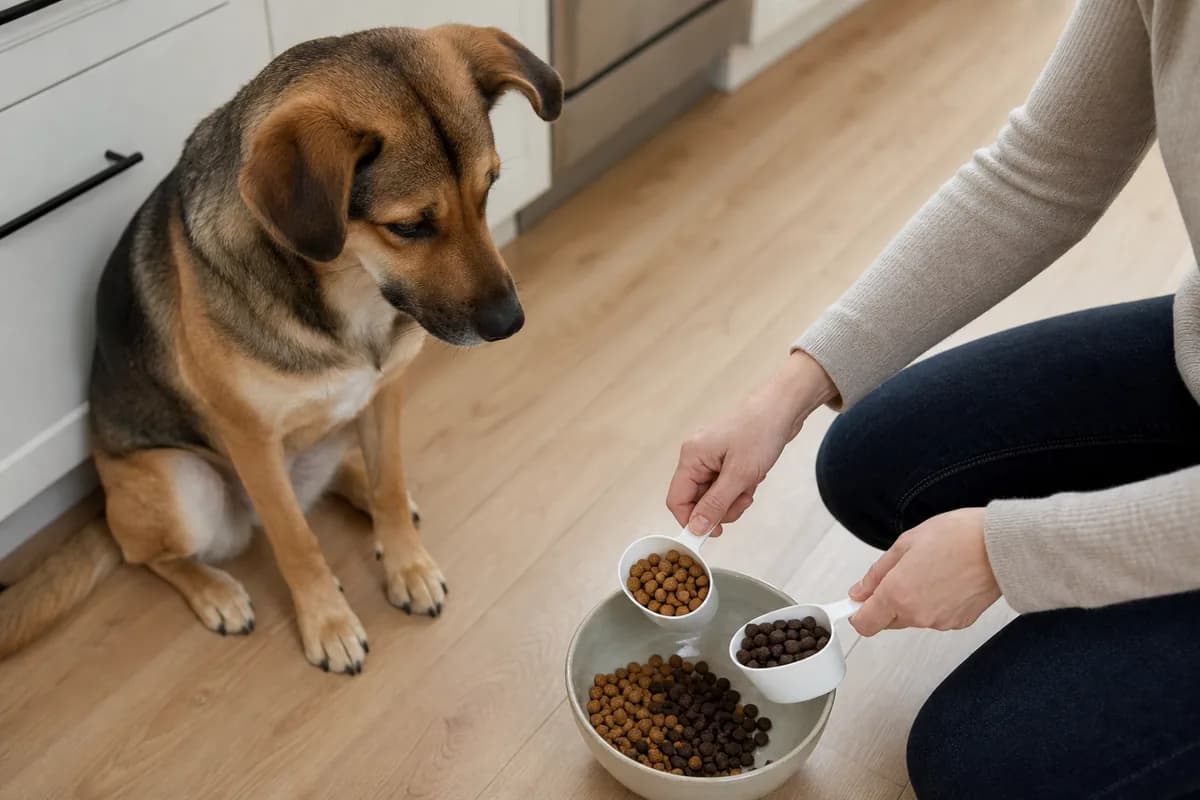
If your veterinarian or manufacturer has not given another schedule, a gradual seven-day change is a practical starting point:
| Days | Puppy food | Adult food |
|---|---|---|
| 1–2 | 75% | 25% |
| 3–4 | 50% | 50% |
| 5–6 | 25% | 75% |
| 7 onward | 0% | 100% |
Sensitive dogs may need a slower transition. Measure by calories as well as cups: the new food can have a different calorie density, so replacing one cup with one cup may accidentally raise or lower intake.
Track stool, appetite, weight, and body condition. A small stool change can occur, but repeated vomiting, marked diarrhea, pain, refusal to eat, or lethargy needs veterinary advice.
What happens to the feeding amount?
Do not carry the puppy portion straight across. Recalculate from the adult food's calories and the dog's current needs, then adjust against weight and body condition. Keep treats in the total.
The PawAI Puppy Plan helps you recognize when rapid growth is slowing. When the switch is complete, use the dog calorie calculator as a starting point for adult maintenance and continue regular weigh-ins. Before changing foods, compare the current routine with puppy feeding amounts by age.
Sources
Frequently asked questions
Can I keep feeding puppy food after my dog stops growing?
Growth food is often more calorie-dense and formulated for a different life stage. Continuing it without a reason can make weight control harder. Review the transition when growth slows rather than changing automatically on a birthday.
What if my dog gets diarrhea during the transition?
Return to the last ratio the dog tolerated and slow the change. Contact your veterinarian if diarrhea is persistent, severe, bloody, accompanied by vomiting or lethargy, or occurs in a very young puppy.
Put this into practice
Calculate your pet’s daily calories →Curious how the numbers work? See how we calculate.
This article is educational and is not veterinary advice. For a diagnosis or a treatment plan, consult a licensed veterinarian who can examine your pet.