
How Many Calories Are in a Cup of Dog Food?
There is no single answer: a standard cup of dry dog food runs from roughly 300 to over 500 calories depending on the formula, because calorie density varies by brand and recipe. Feed by your dog's calculated calorie needs and the food's stated kilocalories per cup, not by a generic scoop, or you can overfeed by hundreds of calories a day.
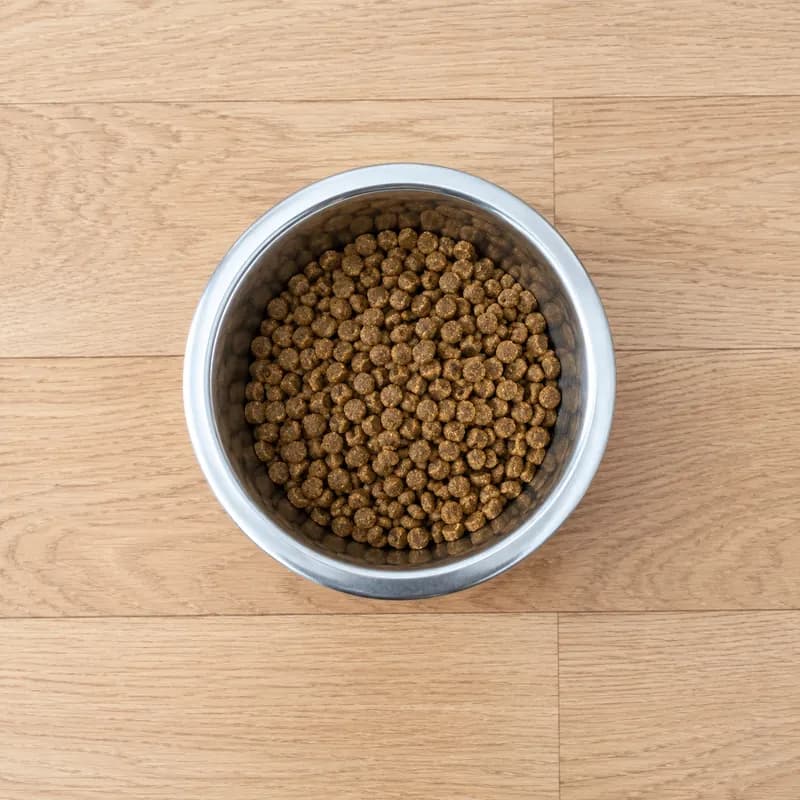
How many calories are actually in a cup of dog food?
Enough to matter, and not a fixed number. Dry dog foods commonly land anywhere from about 300 to more than 500 kilocalories per 8-ounce cup, because kibble recipes differ in fat and density. That spread means "one cup twice a day" can be an appropriate ration for one dog and a steady weight-gain plan for another of the same size.
Every complete dog food sold in the United States must print a calorie-content statement — kilocalories per cup and per kilogram. That number, not the scoop, is what you feed to.
Why is feeding by the cup a problem?
Because the cup hides the calories. If you switch from a 350-kcal/cup food to a 480-kcal/cup food and keep pouring "a cup," you just added 260 calories a day without changing anything you can see. For a 30-pound dog that can be a third of the daily budget.
Getting this wrong is common and consequential. In one canine weight-loss study, 64.4% of dogs failed to reach the recommended weekly weight-loss rate, and the strongest predictor of failure was owners not following the feeding plan — overwhelmingly, feeding more than prescribed (canine weight-loss review, PMC). Portion drift through the measuring cup is a big part of that.
How do I calculate how many calories my dog needs?
Start from resting energy requirement (RER), the calories a dog burns at rest. The WSAVA feeding chart gives the standard formula (WSAVA energy chart):
- RER = 70 × (ideal body weight in kg)^0.75
- For dogs 2–30 kg, this is well approximated by 30 × weight(kg) + 70
Daily maintenance energy is RER multiplied by an activity/life-stage factor (typically about 1.4–1.6 for a neutered adult pet dog; less for weight loss). The table shows rough resting needs at a few weights.
| Ideal weight | RER (approx.) | Typical adult maintenance |
|---|---|---|
| 5 kg (11 lb) | ~235 kcal | ~330–375 kcal/day |
| 10 kg (22 lb) | ~370 kcal | ~520–590 kcal/day |
| 20 kg (44 lb) | ~625 kcal | ~875–1000 kcal/day |
| 30 kg (66 lb) | ~845 kcal | ~1180–1350 kcal/day |
These are starting estimates; individual dogs vary, so verify against body condition over several weeks. Our dog calorie calculator does this math for you, and how we calculate shows every step.
How do I turn calories into cups?
Once you know the daily target, divide by the food's stated kcal per cup:
Daily cups = daily calorie target ÷ kcal per cup (from the bag)
Better still, weigh the food. Convert your target to grams using the kcal/kg on the label and use a kitchen scale. Weighing removes the single biggest source of accidental overfeeding.
If your dog is carrying extra weight, don't just cut cups by eye — read how much weight a dog should lose per week and confirm where your dog stands with our body condition check. To understand why two foods with the same "cup" feed so differently, see dog food calorie density explained.
Sources
Frequently asked questions
Where do I find the calories in my dog's food?
Look for the "calorie content" or "metabolizable energy" statement on the bag, given as kcal per cup and kcal per kilogram. Every complete pet food sold in the US must declare it.
Is a "cup" a real measurement?
A measuring cup is a volume, not a weight. The same cup holds different calories for different foods, so two dogs fed "one cup" can get very different energy.
Put this into practice
Calculate your pet’s daily calories →Curious how the numbers work? See how we calculate.
This article is educational and is not veterinary advice. For a diagnosis or a treatment plan, consult a licensed veterinarian who can examine your pet.